
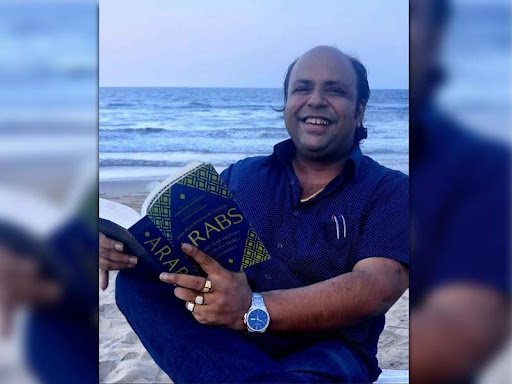
Short posts and quick content have changed how people read. Yet, for Dr. Shadab Ahmed, classical poetry still deserves time and attention.
A professional Maxillofacial Surgeon and an award-winning author, poet and translator – Dr. Ahmed has spent years studying poetry from Persian, Indian, Turkish, Spanish, Portuguese, European, Mandarin, Hebrew, Russian, and Iberian traditions.
Through a decade of reading, studying, and engaging with poetic traditions across continents, Dr. Ahmed has cultivated an oeuvre that functions as a literary bridge between vanishing cultural idioms and the contemporary English-speaking reader. Across his body of work, the voices of remote and fading literary traditions are summoned into the present through an elaborate orchestration of erudition, linguistic refinement, and inventive wordcraft, where historical consciousness and poetic imagination exist in sustained dialogue.
On the one hand, his celebrated historical translations derive their authority from an exacting fidelity to historical detail, cultural nuance, and textual authenticity, yet are rendered through a resonant synthesis of verse and prose that gives archival material a distinctly literary vitality. On the other, his poetry and translations inhabit a markedly more aristocratic and introspective register, where elaborate verbal arabesques, Victorian refinement, Persianate sensibilities, and densely layered imagery converge together. The resulting language is at once ornate and cerebral, sensuous in its texture, meticulous in its construction, and evocative in its emotional afterlife – revealing a writer whose engagement with translation is not merely linguistic but profoundly cultural and philosophical.
The Human Stories That Outlive Their Time
For Dr. Ahmed, classical poetry consequently occupies a dual significance: it is both an inheritance of literary art and a record of lived human experience. His scholarly engagement with these traditions extends beyond translation alone. He studies their historical settings, literary forms, cultural references, and emotional worlds, seeking to preserve the character of the original while making its meaning accessible to the contemporary reader. In doing so, he assumes the role of both scholar and cultural interpreter – tracing the connections between text and history, language and society, and poetic expression and human experience.
His work thus brings neglected or distant literary voices into renewed conversation with the present. Rather than treating classical poetry as a relic of the past, Dr. Ahmed approaches it as a continuing source of insight into human thought and feeling, allowing readers separated from these works by language, geography, and centuries of history to encounter their ideas with greater clarity and their emotional force with renewed immediacy.
Making Room for Poetry in the Age of Quick Content
Dr. Ahmed’s work emerges at a time when reading habits are changing rapidly and the distance between contemporary readers and classical literature is growing wider. Against this changing literary landscape, his books and translations make a compelling case for returning to works that demand patience, reflection, and sustained attention. The poets he studies may belong to distant centuries and cultures, yet their reflections on love, loss, faith, ambition, mortality, and human longing continue to speak to readers with remarkable immediacy.
For Dr. Shadab Ahmed, bringing these works before a modern audience is not simply an exercise in literary preservation. It is an act of cultural continuity—a way of ensuring that voices shaped by other centuries are not silenced by the passage of time. Through his scholarship and translations, he gives these works another life in another language, opening their ideas and emotions to readers who might otherwise never encounter them. For when a language preserves a poem, it preserves more than words—it preserves a way of seeing the world; and when that poem reaches another generation, a fragment of that world lives again.

