
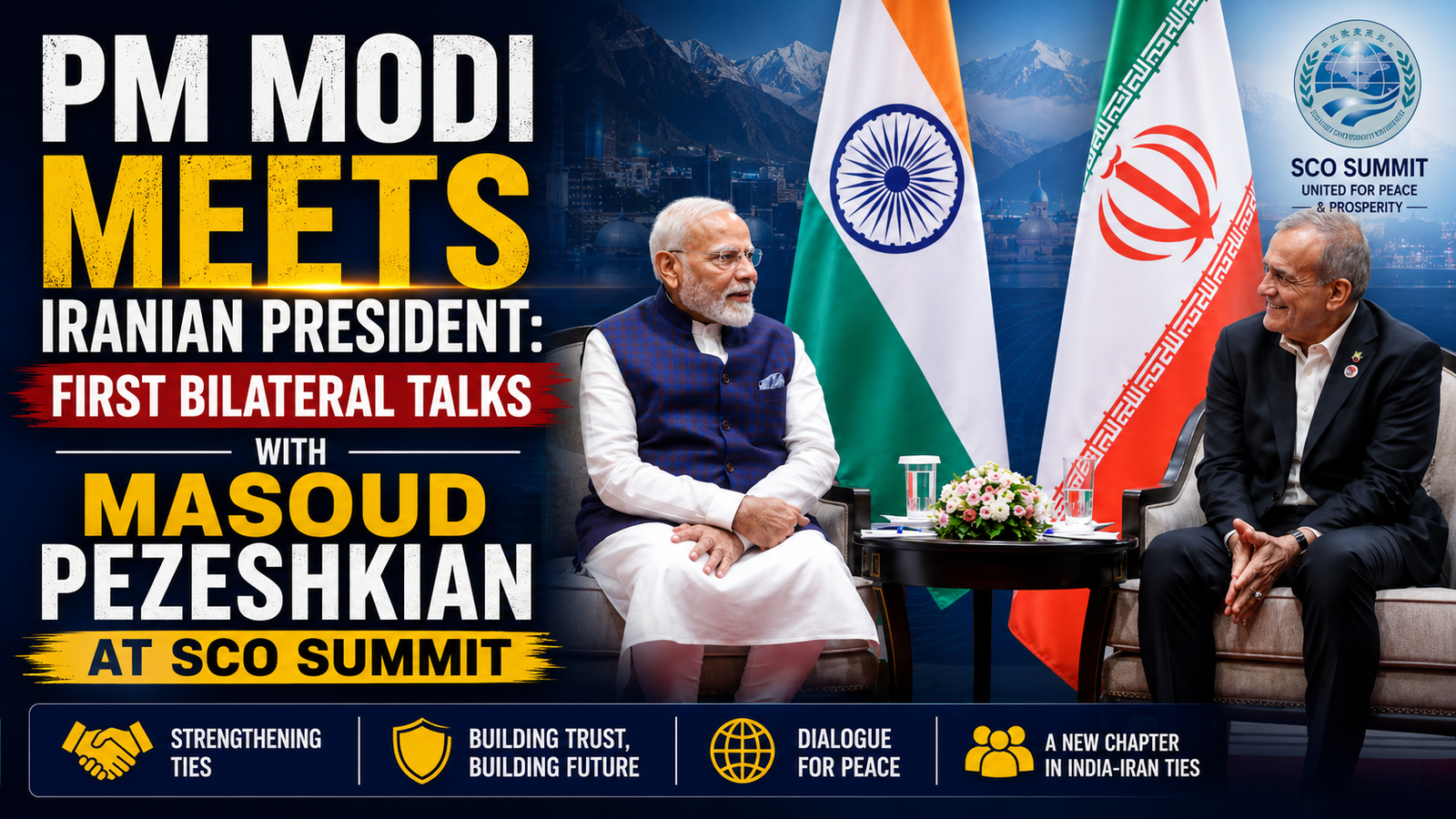
PM Modi Meets Iranian President: First Bilateral Talks With Masoud Pezeshkian
PM Modi Meets Iranian President Masoud Pezeshkian for the first time in a bilateral meeting on the sidelines of the Shanghai Cooperation Organisation (SCO) Summit in Kyrgyzstan. The meeting marks an important diplomatic engagement between India and Iran and comes as both countries continue to maintain dialogue on regional, economic and strategic matters.
Prime Minister Narendra Modi and Iranian President Masoud Pezeshkian held their first bilateral talks during the summit, creating an opportunity for the two leaders to discuss areas of mutual interest and developments affecting the wider region.
PM Modi Meets Iranian President at the SCO Summit
The meeting between Prime Minister Narendra Modi and President Masoud Pezeshkian took place on the sidelines of the SCO Summit in Kyrgyzstan.
The interaction was significant because it marked the first bilateral discussion between the two leaders. Meetings of this nature allow heads of government to directly exchange views on issues that affect their countries and broader regional interests.
For India, engagement with Iran remains important because of the country’s geographical position, economic relevance and role in regional connectivity.
Who Is Masoud Pezeshkian?
Masoud Pezeshkian is the President of Iran and has emerged as an important figure in the country’s engagement with the international community.
His meeting with Prime Minister Modi provides an opportunity for India and Iran to maintain direct political communication at the highest level.
India has traditionally maintained relations with Iran based on several areas of common interest, including trade, connectivity, energy and regional cooperation.
Importance of India-Iran Relations
India and Iran share longstanding diplomatic and economic relations.
The two countries have worked together in areas involving trade, infrastructure and connectivity. Iran’s geographical location makes it particularly important for India’s efforts to strengthen links with Central Asia and other markets.
India’s relationship with Iran also has significance because developments in West Asia can have an impact on India’s economic and strategic interests.
Maintaining diplomatic communication therefore remains an important part of India’s broader foreign-policy approach.
Why the Meeting Matters
The first bilateral meeting between Modi and Pezeshkian provides an opportunity to establish a direct channel of communication between the two leaders.
High-level meetings can help countries understand each other’s priorities and identify areas where cooperation can be expanded.
Such discussions are especially important when countries operate in a rapidly changing geopolitical environment.
For India, maintaining constructive relations with multiple countries is an important element of its diplomatic strategy.
The Role of the SCO Summit
The Shanghai Cooperation Organisation provides a major platform for regional dialogue and cooperation.
The organisation brings together countries from across Asia and provides opportunities to discuss issues including regional security, economic cooperation and connectivity.
For India, participation in the SCO also provides an opportunity to strengthen engagement with Central Asian and Eurasian countries.
Bilateral meetings held alongside the summit add another layer to India’s diplomatic outreach.
Regional Geopolitical Importance
The Modi-Pezeshkian meeting comes against a backdrop of significant geopolitical developments across West Asia and the broader Eurasian region.
India has consistently advocated dialogue and diplomatic engagement while maintaining relationships with countries across different geopolitical groupings.
Iran’s position between South Asia, Central Asia and West Asia makes it strategically important.
Continued communication between India and Iran can therefore help both sides exchange views on developments that affect their respective interests.
Connectivity Is a Major Area of Interest
Connectivity is one of the most important areas in India’s relationship with Iran.
Iran can serve as a geographical link between India and markets in Central Asia and beyond.
India has long viewed improved connectivity with Central Asia as an important economic and strategic objective.
Infrastructure and transport links involving Iran can provide additional routes for trade and regional economic cooperation.
This makes diplomatic engagement between New Delhi and Tehran particularly relevant to India’s long-term connectivity ambitions.
Economic Cooperation Between India and Iran
Trade and economic relations are another important component of bilateral engagement.
India and Iran have economic interests that extend across multiple sectors.
However, international geopolitical developments and financial restrictions have created challenges for businesses and governments seeking to expand bilateral trade.
Continued political dialogue can help both countries explore opportunities for economic cooperation while taking into account the wider international environment.
Energy Remains Relevant
Energy has historically been an important part of India’s engagement with Iran.
India is one of the world’s largest energy-consuming economies, making energy security an important component of its foreign policy.
Iran, meanwhile, is a major energy-producing country with significant oil and gas resources.
Changes in global energy markets can therefore make India-Iran engagement economically significant.
India’s Balanced Diplomatic Approach
India has increasingly followed a diplomatic approach that seeks to maintain strong relationships with multiple global and regional powers.
New Delhi engages with countries that may have different geopolitical positions while focusing on India’s own national interests.
The meeting between Modi and Pezeshkian reflects this approach.
By maintaining direct communication with Iran, India can continue to pursue its interests in connectivity, trade, energy and regional stability.
Potential Areas of Future Cooperation
The first bilateral meeting could provide a foundation for continued engagement between India and Iran.
Future discussions could cover connectivity projects, trade, energy cooperation, regional developments and broader economic relations.
The two countries may also continue discussions through diplomatic and ministerial channels.
The effectiveness of future cooperation will depend on regional conditions as well as developments in international relations.
Significance for India’s Foreign Policy
The meeting also highlights India’s growing diplomatic engagement across Eurasia.
India’s participation in organisations such as the SCO allows it to engage directly with a wide range of countries.
At the same time, bilateral meetings allow India to focus on specific relationships and issues.
The Modi-Pezeshkian interaction therefore has significance beyond the immediate meeting, as it forms part of India’s broader strategy of maintaining active diplomatic relationships across different regions.
What the Meeting Could Mean Going Forward
The first bilateral talks between Modi and Pezeshkian could help establish a framework for future engagement.
Both countries have several areas where their interests overlap, particularly in connectivity and regional economic cooperation.
At the same time, the wider geopolitical environment presents challenges that require careful diplomatic management.
Regular communication can help India and Iran address these challenges while continuing to explore areas of mutual benefit.
PM Modi Meets Iranian President: Key Takeaway
PM Modi Meets Iranian President Masoud Pezeshkian for their first bilateral talks on the sidelines of the SCO Summit in Kyrgyzstan.
The meeting represents an important diplomatic engagement between India and Iran and provides an opportunity for the two leaders to discuss mutual interests and regional developments.
India and Iran have longstanding ties involving connectivity, trade, energy and regional cooperation. Iran’s geographical position also makes it important to India’s efforts to strengthen economic links with Central Asia.
The meeting could help maintain high-level communication between New Delhi and Tehran and potentially create opportunities for greater cooperation in the future.
Frequently Asked Questions (FAQs)
1. When did PM Modi meet Iranian President Masoud Pezeshkian?
PM Modi met Iranian President Masoud Pezeshkian on the sidelines of the SCO Summit in Kyrgyzstan.
2. Was this PM Modi’s first bilateral meeting with Pezeshkian?
Yes. The meeting marked the first bilateral talks between Prime Minister Narendra Modi and President Masoud Pezeshkian.
3. Where did the meeting take place?
The meeting took place on the sidelines of the Shanghai Cooperation Organisation Summit in Kyrgyzstan.
4. Why are India-Iran relations important?
India and Iran have longstanding interests in trade, connectivity, energy and regional cooperation.
5. What role does Iran play in India’s connectivity plans?
Iran’s geographical position provides India with potential connectivity routes towards Central Asia and other regional markets.
6. What is the SCO?
The Shanghai Cooperation Organisation is a regional organisation that provides a platform for dialogue and cooperation among participating countries.
7. Why was the Modi-Pezeshkian meeting significant?
It was the first bilateral discussion between the two leaders and provided an opportunity to strengthen high-level India-Iran diplomatic engagement.
8. Could the meeting strengthen India-Iran relations?
Continued high-level dialogue can support diplomatic engagement and create opportunities for cooperation in areas of mutual interest.
9. What are the major areas of India-Iran cooperation?
Important areas include connectivity, trade, energy, infrastructure and regional cooperation.
10. What could happen after the meeting?
India and Iran could continue discussions through diplomatic channels on connectivity, economic cooperation, energy and regional developments.

