
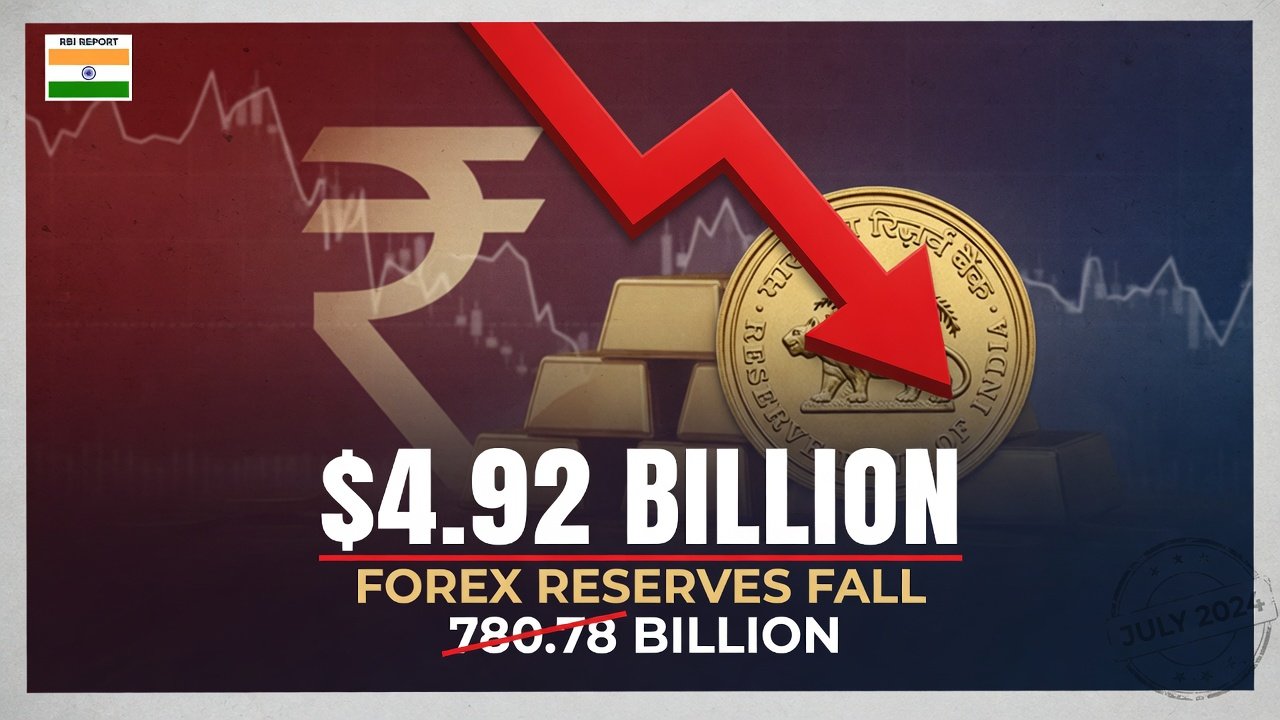
India’s Forex Reserves Fall $4.92 Billion to $780.78 Billion
India’s foreign exchange reserves declined by $4.92 billion to $780.78 billion in the week ended September 11, 2026, according to the latest data released by the Reserve Bank of India (RBI). The weekly decline was mainly driven by reductions in foreign currency assets and the value of gold reserves.
The decline came just one week after India’s forex reserves reached a record $785.71 billion, following a sharp $44.90 billion weekly increase.
India Forex Reserves Decline After Record High
India’s forex reserves had reached an all-time high of $785.71 billion during the week ended September 4. The latest $4.92 billion decline therefore represents a pullback from that record level rather than a reversal of the broader increase seen over recent months.
Despite the weekly fall, the reserves remained substantially higher than both their end-March 2026 level and their level a year earlier.
According to RBI data reported by ANI, total reserves were $89.67 billion higher than at the end of March 2026 and $77.82 billion higher year-on-year.
Foreign Currency Assets Fall $2.37 Billion
Foreign currency assets (FCA), the largest component of India’s forex reserves, declined by $2.37 billion to $645.80 billion during the week ended September 11.
FCA holdings include major foreign currencies held as part of the country’s reserves. Their dollar value can also change because of movements in exchange rates involving currencies such as the euro, pound and yen.
Despite the weekly decline, FCA holdings remained significantly above their levels at the end of March and a year earlier. RBI data showed FCA holdings were about $95.89 billion higher than at end-March and $63.69 billion higher year-on-year.
Gold Reserves Also Decline
Gold reserves were another major contributor to the weekly decline.
The value of India’s gold reserves fell by around $2.59 billion to $111.22 billion during the reporting week, according to RBI data cited by PTI and ANI.
The change reflects the dollar value of the gold component of the country’s reserve assets. Gold valuations can fluctuate with international gold prices and exchange-rate movements.
Despite the weekly decline, India’s gold reserves remained higher than a year earlier. According to the latest data, gold reserves were about $18.81 billion higher year-on-year.
Special Drawing Rights Increase
While foreign currency assets and gold declined, India’s Special Drawing Rights (SDRs) with the International Monetary Fund increased slightly.
SDR holdings rose by approximately $39 million to $18.85 billion during the week. India’s reserve position with the IMF remained broadly unchanged at around $4.92 billion.
The movements across these components explain the overall weekly change in India’s foreign exchange reserves.
Reserves Remain Above End-March Level
The latest decline has not erased the substantial increase recorded by India’s reserves since the beginning of the financial year.
Compared with the end of March 2026, total forex reserves were higher by $89.67 billion as of September 11. Foreign currency assets alone were up by approximately $93.51 billion over the same period.
This provides context for the latest weekly movement. Although reserves declined from their record level, the overall stock of reserves remained considerably higher than it was at the end of March.
Record $44.90 Billion Jump Came Before the Decline
The latest movement follows an unusually large increase in the previous reporting week.
India’s forex reserves jumped $44.90 billion to $785.71 billion in the week ended September 4, marking a new lifetime high.
The scale of that increase means the subsequent $4.92 billion decline still leaves reserves close to the record level.
Recent reports have linked the sharp increase in reserves to large foreign-currency inflows associated with the RBI’s Foreign Currency Non-Resident Bank (FCNR(B)) deposit scheme. Reuters also reported that substantial inflows under the scheme had increased banking-system liquidity and contributed to the rise in reserves.
Forex Reserves and the Indian Rupee
India’s forex reserves are closely watched because they provide a buffer against external financial pressures and can support the RBI’s ability to manage excessive volatility in the foreign-exchange market.
The rupee has faced pressure in September amid elevated global oil prices and changing expectations around US interest rates. Reuters reported that the rupee fell to 96.08 per US dollar on September 17, its weakest level in more than a month, with traders saying the RBI was likely intervening in the foreign-exchange market.
A large reserve stock gives the central bank additional foreign-currency resources when managing disorderly market movements, although reserves are not used to target a particular exchange-rate level.
Why Foreign Currency Assets Matter
Foreign currency assets form the largest part of India’s overall reserve holdings, making changes in this component particularly important when assessing weekly movements.
The value of FCA can change not only because of transactions by the central bank but also because of exchange-rate movements involving the currencies included in the reserve portfolio. As a result, a weekly decline does not necessarily mean that the RBI has sold the equivalent amount of foreign currency in the market.
In the latest week, FCA fell $2.37 billion while remaining substantially above both March and year-earlier levels.
India’s External Financial Buffer
Foreign exchange reserves serve several functions for an economy such as India. They can help meet external payment requirements, provide confidence during periods of global financial stress and give the central bank room to address excessive volatility in currency markets.
India’s current reserve level remains close to its recent record, even after the latest decline. The year-on-year increase also indicates that the country has built a substantially larger reserve cushion compared with the same period last year.
Looking Ahead
India’s forex reserves stood at $780.78 billion for the week ended September 11, down $4.92 billion from the previous week. The decline was mainly driven by a $2.37 billion fall in foreign currency assets and a roughly $2.59 billion reduction in the value of gold reserves.
The latest figure remains close to the record $785.71 billion reached just a week earlier. With reserves still significantly above their end-March and year-earlier levels, future data will show whether the recent decline represents a short-term fluctuation or the beginning of a more sustained movement in India’s reserve position.
FAQs
1. What are India’s forex reserves currently?
India’s foreign exchange reserves stood at $780.78 billion for the week ended September 11, 2026.
2. How much did India’s forex reserves fall?
India’s forex reserves declined by $4.92 billion during the week ended September 11.
3. Why did India’s forex reserves decline?
The decline was mainly driven by falls in foreign currency assets and gold reserves.
4. How much are India’s foreign currency assets?
Foreign currency assets stood at approximately $645.80 billion after declining by $2.37 billion during the week.
5. How much are India’s gold reserves?
India’s gold reserves were valued at approximately $111.22 billion as of September 11, 2026.
6. What was India’s record forex reserve level?
India’s forex reserves reached a record $785.71 billion in the week ended September 4, 2026.
7. How much did forex reserves increase in the previous week?
India’s reserves increased by a record $44.90 billion during the week ended September 4.
8. Are India’s forex reserves higher than last year?
Yes. Total reserves were approximately $77.82 billion higher year-on-year as of September 11, according to RBI data.
9. What are Special Drawing Rights in forex reserves?
Special Drawing Rights, or SDRs, are an international reserve asset created by the IMF. India’s SDR holdings increased by about $39 million to $18.85 billion during the latest reporting week.
10. Why are forex reserves important for India?
Forex reserves provide an external financial buffer and give the RBI foreign-currency resources that can be used to manage external payment needs and excessive volatility in the foreign-exchange market.

