
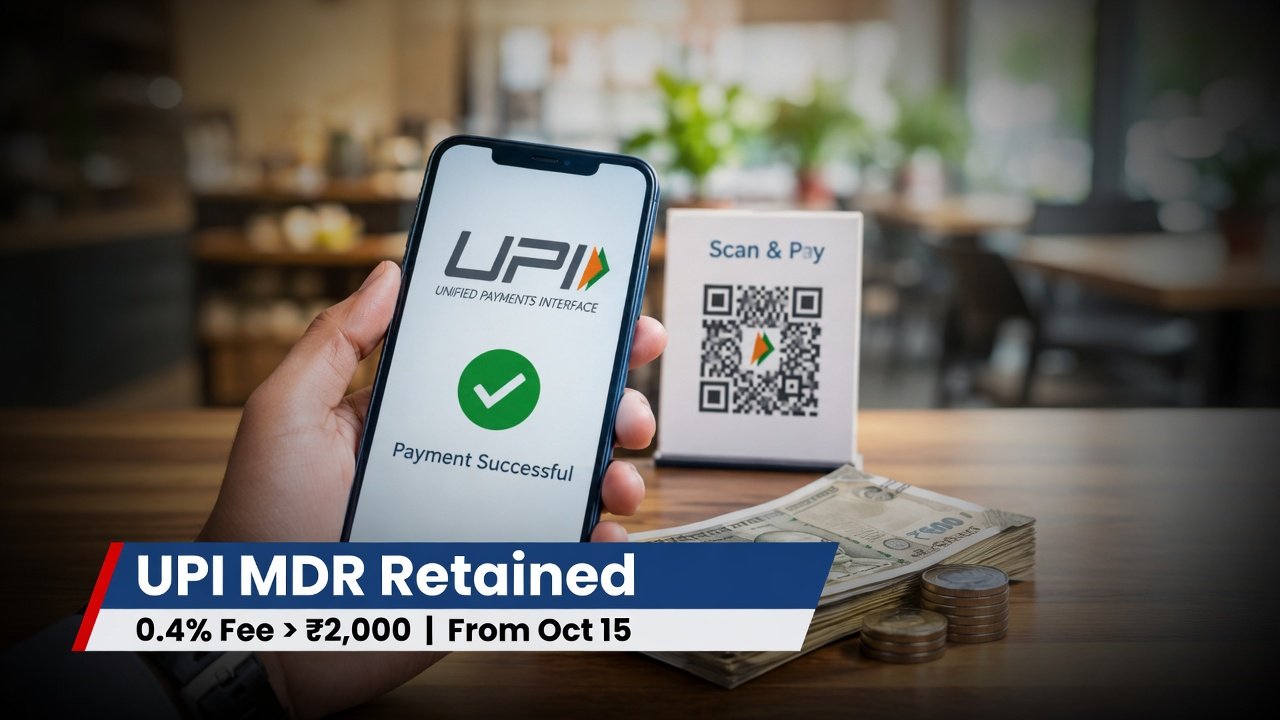
UPI MDR Charges Retained: 0.4% Fee on Transactions Above ₹2,000 From October 15
UPI MDR charges retained has become a key development in India’s digital payments ecosystem after the government ruled out any rollback of the proposed 0.4% Merchant Discount Rate (MDR) on eligible merchant UPI transactions above ₹2,000.
The new framework is scheduled to take effect from October 15, 2026. Importantly, the charge is designed to apply within the merchant-payment ecosystem rather than directly to consumers. Government officials have said there is no question of reversing the decision.
What Is the New UPI MDR Charge?
Under the new framework, eligible person-to-merchant (P2M) UPI transactions above ₹2,000 will attract an MDR of 0.4%.
MDR is a fee associated with processing a digital payment and is paid within the payments ecosystem to participating banks, payment service providers and other intermediaries. It is not a tax collected by the government.
The standard MDR will also have a maximum cap of ₹300 for transactions of ₹75,000 or more.
The policy represents a significant change for UPI, which has operated without an MDR for several years. The government and payments authorities have described the new framework as a way to support the long-term financial sustainability, security and infrastructure of the UPI ecosystem.
Government Rules Out Rollback
The decision to retain the UPI MDR comes despite calls from some business groups and political opponents for reconsideration.
A senior government official said there was no question of reversing the decision, indicating that the 0.4% MDR framework would proceed as planned from October 15. Officials have said the decision was taken with the broader UPI ecosystem in mind, particularly its financial sustainability and safety.
The Finance Ministry has also stated that the policy is intended to build a sustainable and inclusive digital-payment ecosystem. It has rejected suggestions that the decision was driven by foreign influence.
Consumers Will Not Be Directly Charged
One of the most important aspects of the new UPI payment rules is that consumers are not supposed to be charged the MDR.
The fee is intended to remain within the merchant-payment ecosystem. The government is also considering a mechanism to monitor whether businesses attempt to pass the MDR directly on to customers.
Under the framework, eligible merchants will therefore bear the payment-processing cost rather than consumers paying a separate UPI transaction fee.
This distinction is particularly important because UPI has become a routine payment method for millions of consumers across India.
Which UPI Transactions Remain Free?
The new MDR framework does not apply to every UPI payment.
Person-to-person (P2P) transfers, such as sending money to family or friends, will remain free. Similarly, eligible person-to-merchant transactions of ₹2,000 or less will not attract the standard MDR.
Small merchants also receive exemptions under the new system. Businesses classified under the small-merchant P2PM framework and receiving up to ₹1 lakh per month through UPI QR payments can remain exempt from MDR.
This means the impact of the new UPI charges will vary considerably depending on the type and size of a merchant.
Special Rates for Essential Services
The framework also provides different treatment for certain sectors.
Essential or specific categories, including railways, telecom, fuel and insurance, will face a flat ₹5 MDR on eligible transactions above ₹2,000, rather than the standard 0.4% rate.
Capital-market transactions will have a separate MDR of 0.02%, with a maximum cap of ₹300.
These different rates are intended to account for the characteristics of various payment categories and sectors.
Why Is UPI Getting an MDR Now?
UPI has grown dramatically since its introduction and has become one of India’s most important digital-payment systems.
According to Reuters, UPI processed around 24 billion transactions worth $311 billion in August 2026. The scale of the network means that maintaining payment infrastructure, cybersecurity, fraud prevention and customer-support systems requires significant investment.
The government and NPCI have therefore positioned the MDR framework as a way of creating a more sustainable revenue model for the payments ecosystem.
NPCI has said MDR collections can support areas including infrastructure resilience, cybersecurity, fraud prevention, innovation and customer service. A portion of collections will also be directed toward encouraging UPI acceptance among smaller merchants.
What Does the Change Mean for Merchants?
For businesses, the new UPI MDR represents an additional cost for eligible high-value transactions.
For example, a 0.4% MDR on a ₹10,000 transaction would amount to ₹40 before any applicable taxes. On a ₹50,000 transaction, the MDR would be ₹200.
The actual impact will depend on a merchant’s transaction volume, average ticket size and eligibility for exemptions or special rates.
Some businesses have already raised concerns about absorbing the additional cost. A LocalCircles survey reported that only 17% of surveyed merchants said they were willing to bear a 0.4% MDR on UPI payments above ₹2,000. The survey received more than 32,000 responses from merchants and businesses across 242 districts.
Could Merchants Pass the Cost to Customers?
The government has said consumers should not bear the MDR directly.
However, the question of how businesses ultimately account for payment-processing costs remains significant. The government is considering mechanisms to monitor whether merchants pass the cost directly to customers.
This could become particularly relevant for sectors operating on narrow margins, where even a small payment-processing cost can affect transaction economics.
Retailer organizations have also expressed concerns that additional costs could influence how some businesses accept digital payments, particularly during high-volume shopping periods.
UPI’s Free-Payment Era Is Changing
The introduction of MDR marks a shift from the model under which UPI merchant payments had largely remained free for more than six years.
The new structure does not eliminate free UPI payments altogether. Everyday P2P transfers, lower-value eligible merchant payments and qualifying small merchants can continue without the standard MDR.
Instead, the policy creates a selective charging framework focused on certain higher-value merchant transactions.
For payment companies, banks and other participants in the ecosystem, the change could create a new source of revenue. Reuters reported that investors responded positively to the prospect of additional revenue for payment-related businesses following the announcement.
UPI MDR and the Future of Digital Payments
The introduction of UPI MDR could influence the economics of India’s digital-payment industry over the coming months.
For payment companies and banks, MDR revenue could provide greater financial support for infrastructure and technology investments. For merchants, the focus will likely remain on the cost of accepting digital payments and how the new framework affects margins.
The government has also emphasized that small merchants and consumers should remain protected through exemptions and restrictions on passing the MDR directly to users.
A legal challenge has already been filed in the Supreme Court against the new framework, adding another layer of uncertainty around the implementation and future of the policy.
Looking Ahead
The UPI MDR charges retained decision confirms that the 0.4% merchant fee on eligible UPI transactions above ₹2,000 is scheduled to begin on October 15, 2026.
Consumers will continue to have access to free P2P UPI transfers, while eligible small merchants and lower-value transactions will receive exemptions. At the same time, larger merchants will need to account for the new payment-processing cost.
The implementation of the framework, merchant response and the government’s monitoring of potential cost pass-through will determine how significantly the new MDR changes India’s UPI payment landscape.
FAQs
1. What is the new UPI MDR charge?
The new UPI MDR is a 0.4% merchant discount rate on eligible person-to-merchant UPI transactions above ₹2,000.
2. When will the new UPI MDR take effect?
The new MDR framework is scheduled to take effect on October 15, 2026.
3. Will consumers have to pay the 0.4% UPI fee?
No. The framework does not permit the MDR to be directly charged to consumers.
4. Does the MDR apply to UPI payments below ₹2,000?
Eligible person-to-merchant UPI transactions up to ₹2,000 will remain free of MDR.
5. Will UPI-to-UPI transfers between individuals be charged?
No. Person-to-person UPI transfers remain free under the new framework.
6. Are small merchants exempt from UPI MDR?
Qualifying small merchants receiving up to ₹1 lakh per month through UPI QR payments can remain exempt from MDR.
7. What is the maximum MDR on large UPI transactions?
The standard 0.4% MDR is capped at ₹300 for transactions of ₹75,000 or more.
8. Is UPI MDR a tax paid to the government?
No. MDR is a payment-processing fee distributed among participants in the digital-payment ecosystem rather than a tax collected by the government.
9. Which sectors have a special MDR rate?
Certain categories such as railways, telecom, fuel and insurance will face a flat ₹5 MDR on eligible transactions above ₹2,000.
10. Has the government cancelled the UPI MDR proposal?
No. Government officials have ruled out a rollback, and the 0.4% MDR framework is scheduled to begin on October 15, 2026.

