
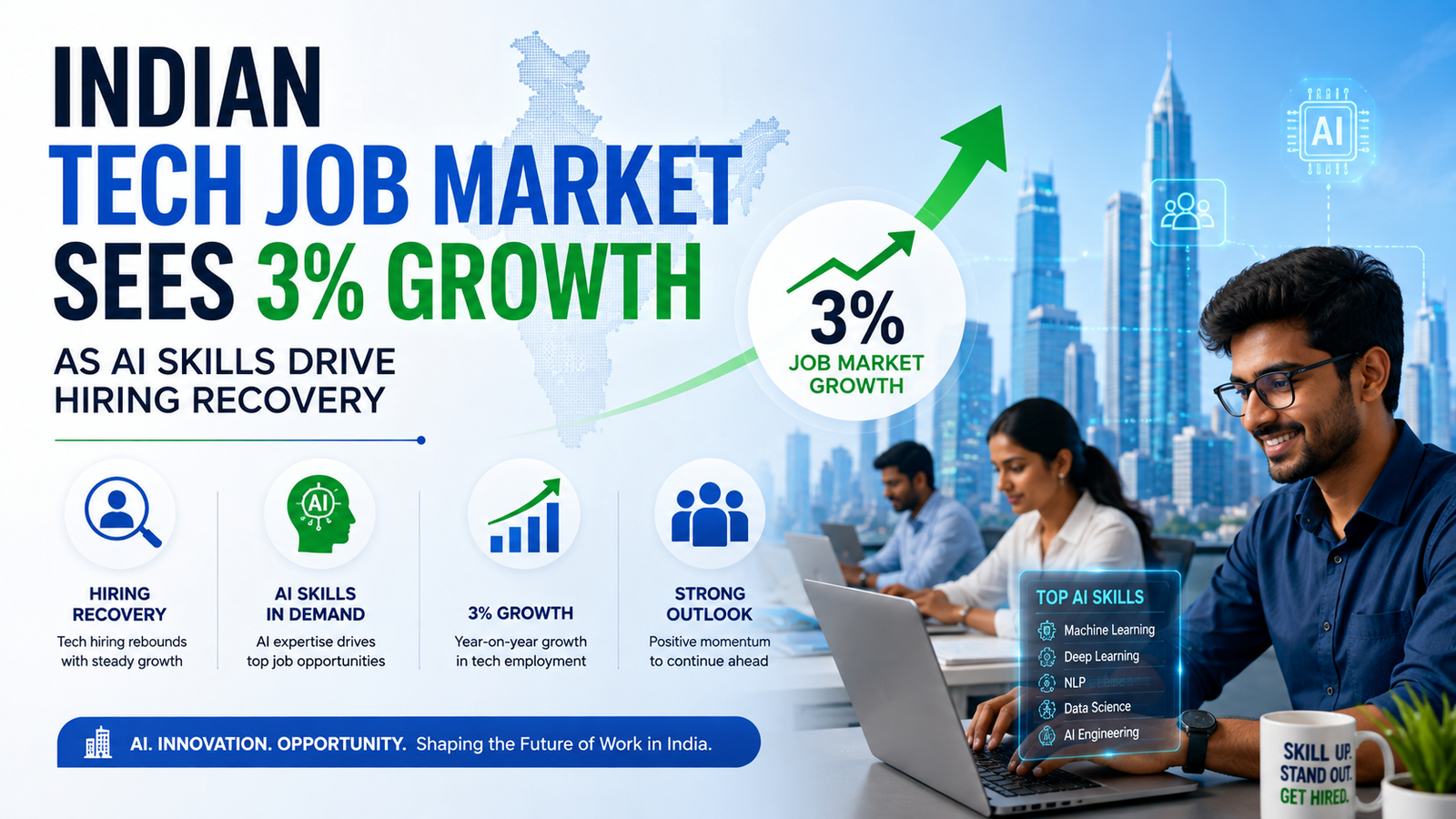
India’s tech job market is showing clear signs of recovery. Active technology job openings increased by 3% month-on-month in August 2026, ending months of slow hiring and signaling renewed confidence across the IT industry. However, this recovery looks very different from previous hiring cycles.
Instead of large-scale recruitment for traditional software maintenance and support roles, companies are now prioritizing professionals with expertise in Artificial Intelligence (AI), Machine Learning (ML), Cloud Computing, and Cybersecurity. At the same time, nearly 73% of Indian technology companies are adopting a train-to-deploy model, helping fresh graduates become project-ready by training them in Generative AI tools before assigning them to client projects.
Why the Indian Tech Job Market Is Recovering
After a cautious hiring phase influenced by global economic uncertainty, IT companies are once again expanding their workforce.
The biggest difference is that companies are hiring for future-ready technologies rather than conventional IT services. Organizations are investing heavily in AI-powered products, cloud infrastructure, automation, and digital transformation, creating fresh opportunities for skilled professionals.
This shift reflects the growing demand for AI-first solutions across industries such as banking, healthcare, retail, manufacturing, and financial services.
AI Skills Are Leading the Hiring Boom
Recruiters are actively searching for candidates with expertise in emerging technologies.
The most in-demand roles include:
- AI and Machine Learning Engineers
- Generative AI Developers
- Cloud Architects
- Cybersecurity Analysts
- Data Engineers
- MLOps Engineers
- DevOps Professionals
- Data Scientists
Professionals with practical experience in these domains are commanding better salaries and enjoying stronger job prospects than candidates focused only on traditional software support roles.
What Is the Train-to-Deploy Model?
One of the biggest hiring trends in 2026 is the train-to-deploy approach.
Instead of expecting fresh graduates to arrive fully industry-ready, companies are hiring promising candidates and providing intensive training in:
- Prompt engineering
- Generative AI tools
- Cloud platforms
- Secure software development
- Enterprise AI workflows
After completing the training, candidates are deployed directly onto live client projects.
This model helps companies address skill shortages while allowing freshers to become productive much faster.
The Shift From Traditional IT to AI-First Development
India’s IT industry is undergoing a structural transformation.
For years, much of the sector focused on software maintenance, application support, and legacy system management.
Today, businesses are increasingly investing in:
- AI-powered business automation
- Intelligent customer support
- Predictive analytics
- Cloud-native applications
- Enterprise copilots
- AI-assisted software development
As a result, companies are looking for professionals who can build intelligent systems rather than simply maintain existing software.
Skills Freshers Should Learn Right Now
Students and early-career professionals hoping to enter the IT industry should prioritize skills that align with current hiring trends.
The most valuable skills include:
Generative AI
Understanding tools like ChatGPT, GitHub Copilot, Claude, and enterprise AI platforms is becoming increasingly valuable.
Python Programming
Python remains one of the most widely used languages for AI, machine learning, automation, and data science.
Cloud Computing
Knowledge of platforms such as AWS, Microsoft Azure, or Google Cloud is highly sought after.
Cybersecurity
With cyber threats becoming more sophisticated, companies continue to invest heavily in security professionals.
Data Analytics
The ability to analyze and interpret business data remains an important competitive advantage across industries.
What This Means for Job Seekers
The latest hiring recovery carries an important message.
Simply having a computer science degree is no longer enough.
Employers increasingly value candidates who can demonstrate practical AI skills, build real-world projects, contribute to open-source repositories, and solve business problems using modern technologies.
Continuous learning has become one of the most valuable career assets in today’s technology industry.
Final Thoughts
The Indian tech job market is regaining momentum, but the nature of hiring has fundamentally changed. AI, cloud computing, cybersecurity, and data engineering are now driving recruitment across the IT sector. With 73% of companies adopting train-to-deploy programs, freshers have more opportunities than ever, provided they invest in the right technical skills.
For aspiring technology professionals, the message is clear. The future belongs to those who combine strong programming fundamentals with practical expertise in AI and emerging technologies.
FAQ
Is the Indian tech job market improving?
Yes. Active technology job openings grew by 3% month-on-month in August 2026, indicating improving hiring activity.
Which tech skills are most in demand in India?
AI, Machine Learning, Generative AI, Cloud Computing, Cybersecurity, Data Engineering, and DevOps are among the most sought-after skills.
What is the train-to-deploy model?
It is a hiring approach where companies recruit candidates first, provide structured technical training, and then assign them to live projects.
Should freshers learn Generative AI?
Yes. Many employers now expect graduates to understand Generative AI tools alongside programming, cloud computing, and data analysis.
Are traditional software jobs disappearing?
Traditional software development and maintenance roles still exist, but hiring growth is increasingly concentrated in AI-first, cloud, and cybersecurity positions.

