
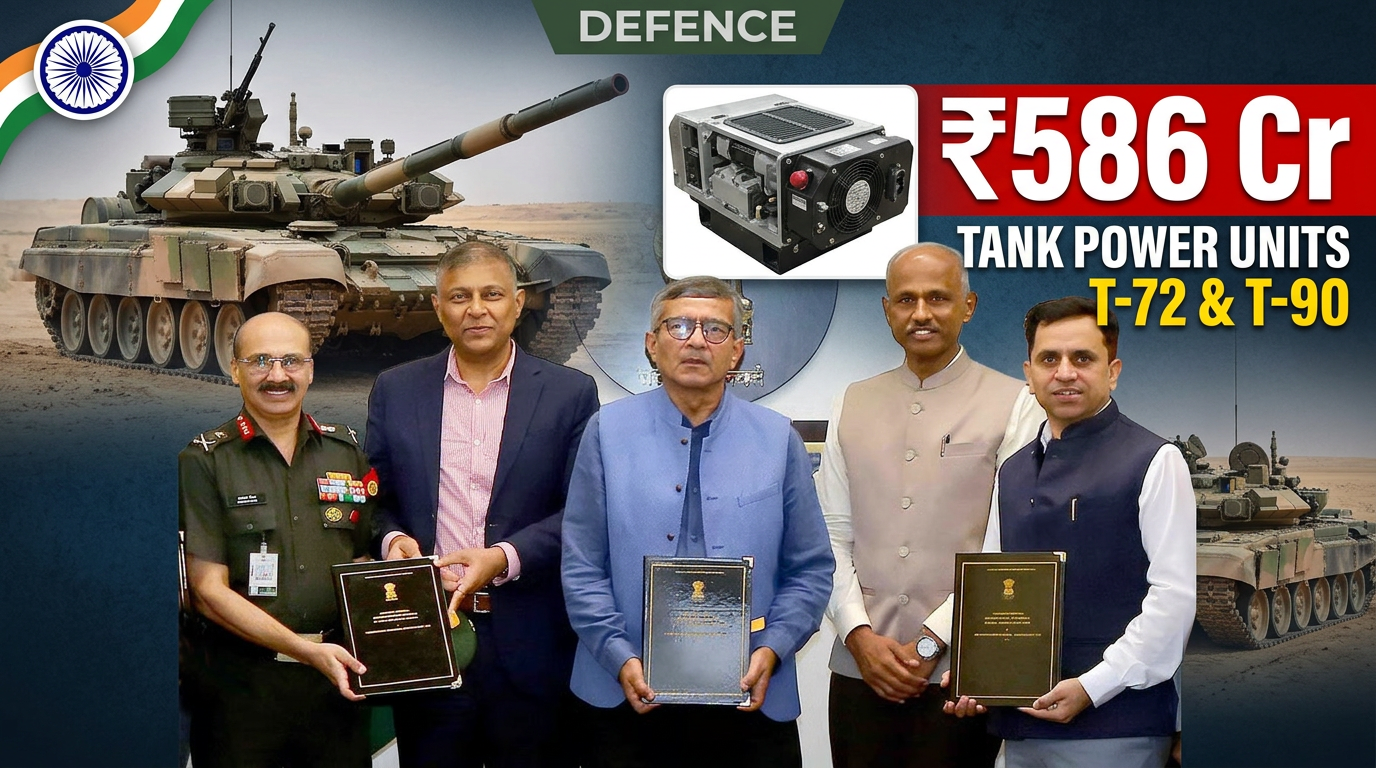
MoD Signs ₹586 Crore Deal With AICPL for Auxiliary Power Units for T-72 and T-90 Tanks
The Ministry of Defence (MoD) has signed a ₹586 crore contract with Accurate Industrial Controls Private Limited (AICPL) for the procurement of Auxiliary Power Units (APUs) for the Indian Army’s T-72 and T-90 main battle tanks.
The contract was signed in New Delhi on September 21, 2026, in the presence of Defence Secretary Rajesh Kumar Singh. The deal is aimed at strengthening the operational readiness and reliability of the Army’s mechanised formations through the induction of indigenously developed tank power systems.
What Are Auxiliary Power Units for Tanks?
An Auxiliary Power Unit, or APU, is an additional power source that can generate electricity for a vehicle’s systems without relying entirely on its main engine.
For the T-72 and T-90 tanks, the APUs will provide an alternate source of electrical power for critical systems, including the fire control system, firing circuit, gun stabilisation system and other tank ancillaries.
This capability allows essential onboard systems to receive electrical power while reducing the need to operate the tank’s primary engine simply to generate electricity.
₹586 Crore Contract Signed With Accurate Industrial Controls
The Ministry of Defence has awarded the ₹586 crore contract to Accurate Industrial Controls Private Limited, an Indian company involved in the development of the APUs.
The agreement represents the transition of an indigenous defence technology from development toward production and induction into the armed forces.
The Ministry described the procurement as an important step toward the indigenisation of critical subsystems used on armoured platforms.
APUs to Support T-72 and T-90 Tank Fleets
The Indian Army operates large fleets of T-72 and T-90 tanks as part of its mechanised formations.
The broader Army requirement for APUs has been reported at 3,257 units, comprising approximately 1,657 units for T-90 tanks and 1,600 units for T-72 tanks. The current ₹586 crore contract is associated with the procurement of these indigenous APUs.
The systems are intended to improve the ability of the tanks to operate their electrical and electronic systems without continuously depending on the main engine.
How APUs Can Improve Tank Operations
Battle tanks require electrical power for several systems even when they are stationary.
Fire-control equipment, gun stabilisation systems and other electronic equipment may need to remain operational while the vehicle’s main engine is not being used for movement.
An auxiliary power system provides an alternative source of electricity for these requirements. This can help reduce unnecessary main-engine operation and support the overall sustainability of armoured platforms.
The Ministry of Defence specifically said the indigenous APUs are expected to strengthen the operational readiness, reliability and sustainability of the Army’s mechanised formations.
Indigenous Development Under Make-II Route
A key aspect of the contract is its connection with the Make-II category of India’s defence procurement framework.
Make-II projects involve industry-led research and development, with Indian companies developing prototypes using their own resources before potential procurement by the armed forces.
The Ministry said the APU contract demonstrates how the Make-II mechanism can help translate indigenous innovation into production and induction.
The approach is part of India’s wider effort to increase domestic development and manufacturing of critical defence equipment and subsystems.
Boost to Defence Indigenisation
The contract is also aligned with the government’s broader focus on Aatmanirbharta in Defence.
Instead of depending entirely on imported systems for critical armoured-platform subsystems, the procurement supports an Indian-developed solution for an important component of the Army’s tank fleet.
The Ministry said the agreement marks a milestone in building a more resilient and self-reliant Indian defence industry and supports the broader vision of Viksit Bharat @2047.
Why the Contract Matters for the Indian Army
The T-72 and T-90 remain important components of India’s armoured forces. Keeping these platforms operationally effective involves not only maintaining their engines and weapons but also upgrading and replacing supporting electronic and power systems.
The introduction of indigenous APUs provides one such capability upgrade.
According to defence reporting, the Army’s requirement for APUs dates back to an Acceptance of Necessity granted in 2019, with the requirement covering both T-72M1 and T-90S tanks.
The current contract therefore represents the movement of an established requirement toward procurement and field induction.
Accurate Industrial Controls’ Role in India’s Defence Industry
The contract also highlights the increasing participation of Indian private-sector companies in defence technology development.
Under the Make-II framework, industry carries the responsibility for developing the required technology, allowing private companies to contribute to the development of equipment for India’s armed forces.
The AICPL agreement demonstrates the role such industry-led development can play in supplying specialised components for established military platforms.
₹586 Crore Deal Supports Broader Modernisation Efforts
The procurement of APUs is part of a wider effort to modernise and sustain India’s existing armoured platforms.
Rather than relying only on completely new platforms, upgrading subsystems can provide additional capabilities and improve the reliability of equipment already in service.
For the T-72 and T-90 fleets, the new APUs will specifically support the electrical requirements of critical tank systems.
The Ministry’s emphasis on indigenous development also means the contract contributes to India’s longer-term objective of developing domestic capabilities across different layers of defence manufacturing.
Defence Procurement Focuses on Indigenous Technology
The ₹586 crore APU contract comes as the Ministry of Defence continues to promote greater participation by Indian companies in defence research, development and production.
The Make-II route is particularly relevant for technologies where private industry can undertake development and subsequently compete for procurement.
The APU programme demonstrates how such a model can be applied to a specialised subsystem rather than an entire weapons platform.
With the contract now signed, the indigenously developed APUs will be introduced for the Army’s T-72 and T-90 tank fleet, supporting the operational requirements of India’s mechanised formations.
Frequently Asked Questions
1. What is the value of the new MoD tank APU contract?
The Ministry of Defence has signed a contract worth ₹586 crore with Accurate Industrial Controls Private Limited for Auxiliary Power Units for T-72 and T-90 tanks.
2. Which company received the ₹586 crore defence contract?
The contract has been signed with Accurate Industrial Controls Private Limited (AICPL).
3. What are Auxiliary Power Units?
Auxiliary Power Units are additional power-generation systems that provide electricity to important vehicle systems without relying entirely on the main engine.
4. Which Indian Army tanks will receive the APUs?
The APUs are intended for the Indian Army’s T-72 and T-90 tanks.
5. What systems will the APUs support?
The APUs will provide an alternate electrical power source for systems including the fire control system, firing circuit, gun stabilisation system and other tank ancillaries.
6. How many APUs does the Army require?
The broader reported requirement is 3,257 APUs, comprising about 1,657 for T-90 tanks and 1,600 for T-72 tanks.
7. When was the ₹586 crore contract signed?
The Ministry of Defence signed the contract on September 21, 2026, in New Delhi.
8. What is the Make-II defence procurement route?
Make-II is a defence procurement category in which Indian industry undertakes the design and development of prototypes, with successful technologies potentially moving toward procurement by the armed forces.
9. Why are indigenous APUs important for India?
Indigenous APUs can reduce dependence on imported subsystems while strengthening domestic defence research, development and manufacturing capabilities.
10. How will the APUs benefit the Indian Army?
The Ministry of Defence says the induction of the indigenous APUs will strengthen the operational readiness, reliability and sustainability of the Army’s mechanised formations.

