
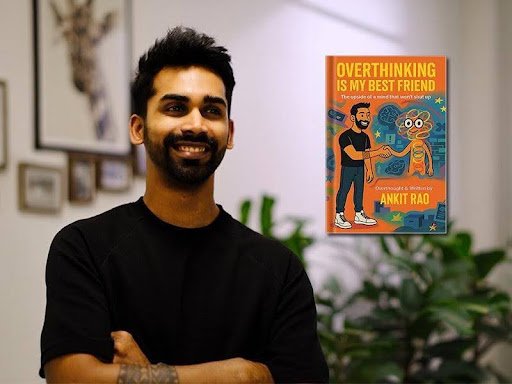
Some books begin with a publishing plan. Others begin with a question that refuses to leave.
Conversations around mental health have never been more visible.
Stress, anxiety, burnout, PTSD, depression, and emotional well-being have become part of everyday discussions across workplaces, schools, and social media. More people are speaking openly about their experiences than ever before.
Yet, according to Overthinking Is My Best Friend by author Ankit Rao, there is one everyday behaviour that quietly exists beneath many of these conversations but rarely becomes the focus of attention:
Overthinking
Unlike anxiety or other mental health conditions, overthinking is not a diagnosable disorder. It is often dismissed as a personality trait or brushed aside with familiar advice such as “stop worrying” or “think less.”
Rao argues that this oversimplifies a far more complex reality. Rather than treating every instance of overthinking as a flaw to be fixed, he believes it should be understood as a natural mental process, one that can foster reflection and growth when managed well, but can also evolve into unhealthy thought spirals when left unchecked.
The Small Habit That Shapes Bigger Patterns
For years, overthinking has been portrayed as something that needs to be eliminated.
People are encouraged to switch off their minds, avoid dwelling on problems, and move on quickly.
But human thought rarely follows simple instructions.
One unanswered message becomes dozens of imagined scenarios.
One difficult decision turns into endless possibilities.
One mistake becomes evidence of future failure.
While overthinking itself is not a medical diagnosis, prolonged and unmanaged thought spirals can contribute to stress and emotional exhaustion. Over time, these patterns may become part of a much larger conversation around mental well-being.
According to Rao, understanding these early patterns deserves far more attention than it currently receives.
The Connection Between Mind and Body
Modern research continues to reinforce the relationship between mental and physical well-being.
Stress can influence sleep quality, digestion, energy levels, concentration, and overall health. The body often responds to thoughts long before a person consciously realizes the impact.
“It’s impossible to separate the mind from the body,” Rao has explained in multiple interviews and public discussions.
The same busy mind that creates worry can also affect how people eat, sleep, work, and interact with those around them.
Recognizing these patterns early may help people develop healthier relationships with their own thinking.
A Different Philosophy
Unlike many personal development books that promise to silence the mind, Rao’s work takes a different approach.
His book, Overthinking Is My Best Friend, argues that overthinking is not inherently negative.
Reflection creates self-awareness.
Analysis improves decision-making.
Curiosity drives learning.
The challenge begins when reflection transforms into an endless spiral with no action or resolution.
Rather than suppressing every difficult thought, Rao advocates understanding which thoughts deserve attention and which ones simply create noise.
The philosophy is built around a simple idea: thinking deeply is not the enemy, but losing control of the spiral can be.
More Than a Book
The book represents only the beginning of a much broader vision.
Rao hopes to expand the conversation around overthinking beyond traditional self-help by creating practical tools, guided journals, digital experiences, and technology that help people better understand their thinking patterns.
The goal is not to diagnose or replace professional mental health care.
Instead, it is to encourage earlier awareness of everyday mental habits that often go unnoticed until they begin affecting relationships, careers, physical wellbeing, and quality of life.
Rethinking the Future of Mental Wellbeing
Society has become increasingly comfortable discussing stress and anxiety after they appear.
Rao believes the next conversation should focus on understanding the everyday thought patterns that come before them.
Because not every busy mind is an unhealthy mind.
Many overthinkers are deeply reflective, empathetic, detail-oriented, and emotionally aware. Their greatest strength and greatest challenge often come from the same place.
The question is no longer whether people think too much.
The question is whether they have been taught how to recognize when healthy reflection becomes an unhealthy spiral.
For Ankit Rao, that conversation extends far beyond the pages of a single book.
It is the foundation of a long-term mission to help people understand their minds instead of spending a lifetime trying to silence them.

