
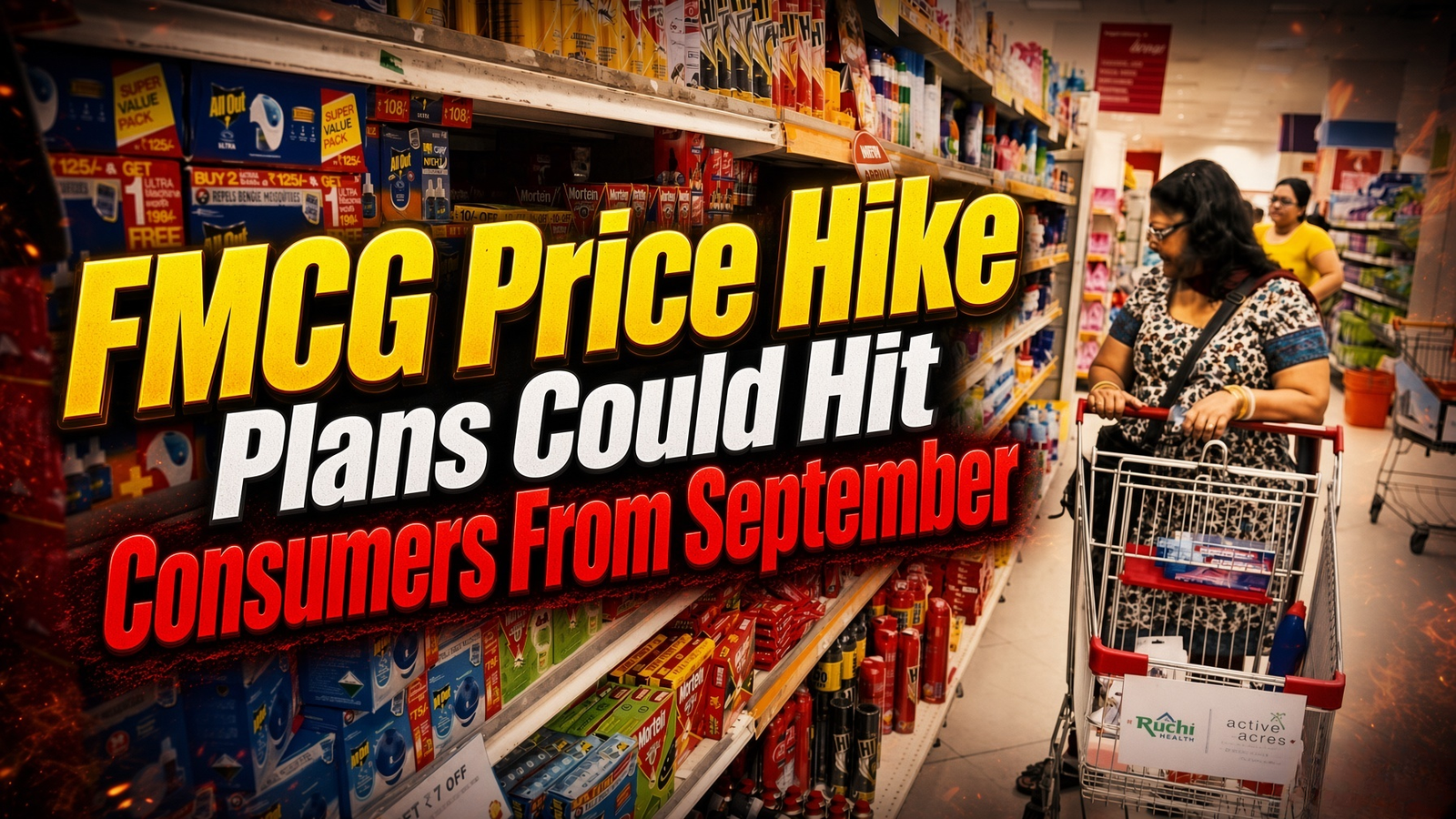
Indian consumers could face higher prices for everyday household products from September as major FMCG companies weigh another round of calibrated price increases and shrinkflation.
Britannia Industries, Hindustan Unilever, Dabur India, Godrej Consumer Products and Tata Consumer Products are among the companies considering pricing action in the September quarter as elevated input costs continue to put pressure on margins.
For shoppers, the impact could take two forms. The price printed on a familiar product could increase, or the company could keep the price unchanged while reducing the quantity inside the pack.
That second approach is known as shrinkflation.
Why Are FMCG Companies Raising Prices?
The latest pricing plans are largely linked to continued pressure on input costs.
FMCG manufacturers depend on commodities, packaging materials, energy, transportation and other inputs whose prices can directly affect production costs.
When those costs rise for an extended period, companies have three broad choices:
- Absorb the higher costs and accept lower margins.
- Increase the selling price.
- Reduce the quantity while keeping the headline price unchanged.
The latest industry signals suggest companies are increasingly looking at the second and third options to protect profitability.
Shrinkflation Could Become the Bigger Consumer Problem
A price increase is easy for shoppers to notice.
Shrinkflation is less obvious.
Under shrinkflation, a product’s price remains the same but the quantity is reduced. For example, a ₹100 product that previously contained 1 kg could be redesigned to contain 900 grams while retaining the same ₹100 price.
The consumer technically pays the same amount, but the price per gram has increased.
This strategy is particularly relevant in India’s highly price-sensitive mass-market FMCG segment, where consumers are accustomed to popular price points such as ₹5, ₹10, ₹20 and ₹50.
Which FMCG Companies Are Considering Price Changes?
Reports indicate that several major companies are evaluating pricing action for the September quarter.
These include:
- Britannia Industries
- Hindustan Unilever
- Dabur India
- Godrej Consumer Products
- Tata Consumer Products
The companies are not necessarily planning identical increases across their entire portfolios. Pricing decisions typically vary by category, product, pack size and consumer demand.
That means shoppers could see different changes across biscuits, personal care products, home-care products, beverages and other everyday categories.
Why Companies Prefer Calibrated Price Hikes
FMCG companies cannot simply increase prices sharply whenever costs rise.
The sector depends heavily on high sales volumes, extensive distribution networks and repeat purchases.
A steep price increase could push consumers toward:
- Cheaper competing brands
- Smaller packs
- Private-label products
- Local alternatives
- Lower consumption
Companies therefore tend to take smaller, targeted pricing actions rather than making large increases across their entire portfolio.
This is why the current industry commentary is focused on calibrated price hikes rather than blanket increases.
What Does This Mean for Household Budgets?
The effect of a small increase on one product may appear insignificant.
The bigger issue is the cumulative impact.
A household buys dozens of FMCG products every month, including biscuits, tea, coffee, toothpaste, soap, shampoo, detergents, packaged foods and beverages.
If several categories become more expensive at the same time, the monthly grocery bill can rise noticeably.
For middle-income and lower-income households, this can force consumers to change brands, reduce quantities or switch to smaller packs.
Are Consumers Still Spending?
Despite the pricing pressure, FMCG companies remain relatively confident about consumer demand.
Recent industry reports indicate that demand has remained resilient even as companies face elevated input costs.
That matters because companies are less likely to push through aggressive price increases if they believe consumers are already cutting back.
The current strategy appears to be finding a balance between protecting margins and keeping products affordable enough to maintain sales volumes.
FMCG Price Hikes Could Affect Inflation
Another round of consumer-product price increases could also have broader implications for India’s inflation picture.
FMCG products form part of household consumption, and persistent increases across food and non-food categories can add pressure to consumer budgets.
The impact will depend on the size of the increases, the number of products affected and how quickly retailers pass those changes on to consumers.
Not every product will necessarily become more expensive.
How Consumers Can Spot Shrinkflation
Consumers can protect themselves by looking beyond the MRP.
When buying regularly used products, compare:
- Net quantity
- Price per 100 grams
- Price per litre
- Number of units in a pack
- MRP versus actual selling price
- Promotional discounts
A product that remains at ₹100 may appear unchanged, but if its quantity falls from 1 kg to 900 grams, the effective unit price has increased.
Checking the unit price is therefore more useful than looking only at the headline MRP.
The Battle Between Pricing and Volume
FMCG companies face a difficult equation.
Higher prices can protect margins but hurt volumes. Lower prices can support demand but squeeze profitability.
This is particularly important for established brands with large distribution networks.
If consumers accept a price increase without significantly reducing purchases, the company can protect margins. If volumes fall sharply, however, the benefit of the price increase can disappear.
That is why companies closely track consumer behaviour after every pricing change.
What Happens From September?
The September quarter is likely to provide a clearer picture of how FMCG companies respond to continued input-cost pressure.
Some products could receive direct price increases. Others could see changes in pack sizes. Companies could also rely on promotions, premium products and cost efficiencies to manage margins.
The exact impact on consumers will vary by brand and category.
For shoppers, however, one message is clear: the same ₹10, ₹50 or ₹100 price point does not always mean the same amount of product.
Final Thoughts
The expected FMCG price hike cycle from September highlights the pressure facing India’s consumer-goods industry.
Britannia, HUL, Dabur, Godrej Consumer and Tata Consumer are among the major players considering calibrated pricing or shrinkflation as companies deal with elevated input costs.
For consumers, the real impact may not always appear as a higher MRP. In some cases, the price could remain unchanged while the quantity inside the pack gets smaller.
That makes checking unit prices increasingly important for households trying to control their monthly grocery spending.
FAQ
Which FMCG companies are considering price hikes?
Britannia, HUL, Dabur, Godrej Consumer and Tata Consumer are among the companies reported to be considering pricing action in the September quarter.
What is shrinkflation?
Shrinkflation occurs when a company reduces the quantity of a product while keeping its price unchanged.
Why are FMCG companies increasing prices?
Elevated input costs and pressure on profit margins are key reasons companies are considering calibrated price increases.
Will all FMCG products become more expensive?
Not necessarily. Pricing decisions vary by product category, brand, pack size and consumer demand.
How can consumers identify shrinkflation?
Compare the net quantity and unit price of a product with previous purchases. A smaller quantity at the same MRP means the effective price per unit has increased.

