
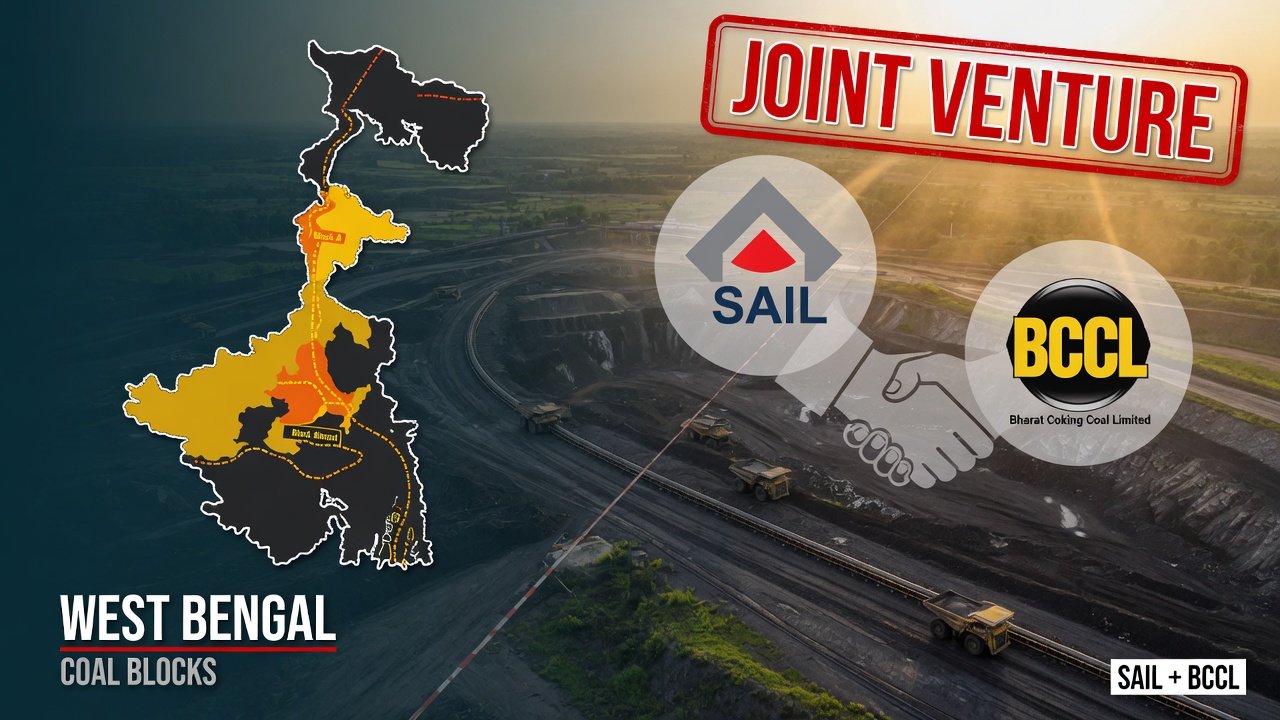
SAIL & BCCL Joint Venture: Two West Bengal Coal Blocks to Be Jointly Developed
SAIL & BCCL Joint Venture plans have moved forward after Steel Authority of India Limited (SAIL) and Bharat Coking Coal Limited (BCCL) signed a Memorandum of Understanding (MoU) for the joint development and operation of two coal blocks in West Bengal.
The agreement, signed on September 25, 2026, covers SAIL’s Indikatta Ramnagore Coal Block and BCCL’s East of Damagoria (Kalyaneshwari) Coal Block. SAIL said the MoU is aimed at developing domestic sources of coking coal, an important raw material for steel production.
The collaboration brings together two public-sector companies with complementary coal assets and is designed around an integrated approach to developing the adjoining blocks.
SAIL & BCCL Joint Venture Covers Two Coal Blocks
Under the SAIL & BCCL Joint Venture arrangement, the companies will jointly develop and operate their respective coal blocks in West Bengal.
The two assets are:
- Indikatta Ramnagore Coal Block — owned by SAIL
- East of Damagoria (Kalyaneshwari) Coal Block — owned by BCCL
Both blocks are located in West Bengal and are being brought under a coordinated mining arrangement.
SAIL’s regulatory disclosure described the agreement as a step toward developing domestic sources of coking coal and strengthening supplies for the steel sector.
Combined Capacity Estimated at 4 Million Tonnes
The two coal blocks are expected to have a combined peak rated capacity of around 4 million tonnes per annum (MTPA).
Reports on the project also put the estimated extractable reserves for Phase I at approximately 79 million tonnes. These figures provide an indication of the potential scale of the proposed integrated mining operation, although the project remains subject to implementation and the required approvals and development processes.
The capacity would make the project relevant to India’s efforts to increase domestic availability of coking coal for steel manufacturing.
Why Coking Coal Is Important for SAIL
Coking coal is a critical raw material in conventional steelmaking because it is used to produce coke, which is required in blast-furnace operations.
India has been working to increase domestic coking coal production and reduce its dependence on imports. The Ministry of Coal has set out a target of increasing domestic raw coking coal production to 140 million tonnes by 2030, while also expanding coal-washing capacity.
For a major steel producer such as SAIL, greater access to domestic coking coal can be strategically important because raw-material availability and costs influence steelmaking operations.
Integrated Mining Model for the Two Blocks
The proposed arrangement is significant because the two coal blocks are adjoining assets that can be developed in an integrated manner.
According to reporting on the project, the mining plan involves coordinating coal extraction and overburden management between the two blocks. In one phase, mining activity in the Kalyaneshwari block can be supported by overburden dumping arrangements involving the Ramnagore block, with the arrangement reversed in a subsequent phase.
This approach is intended to address the practical challenges associated with developing the blocks separately.
BCCL’s annual report had previously noted that the Kalyaneshwari and Ramnagore blocks were proposed for joint exploitation because the individual blocks were not considered suitable for standalone opencast mining. A project report for joint exploitation with a capacity of around 4 MTPA had already been approved by the BCCL and Coal India boards.
SAIL and BCCL Build on Earlier Cooperation
The latest MoU is not the first collaboration between SAIL and BCCL in the coking-coal sector.
The two companies have previously worked together on arrangements involving the supply of washed coking coal. A Ministry of Coal statement noted that SAIL had signed an MoU with BCCL for 1.8 million tonnes of washed coking coal from BCCL washeries.
The latest agreement takes the relationship further by involving joint development and operation of coal assets rather than focusing only on coal supply.
Boost to Domestic Coal Production
The SAIL-BCCL agreement comes as India continues to expand domestic coal production.
According to the Ministry of Coal, India’s overall coal production crossed 1 billion tonnes in each of FY2024-25 and FY2025-26. Domestic coal production was 1,047.52 million tonnes in FY2024-25 and 1,040.08 million tonnes in FY2025-26.
The government has also been promoting commercial coal mining, auction-based allocation and other reforms intended to expand domestic production and improve the efficiency of coal resources.
Coking coal remains a particular focus because of its importance to India’s steel industry.
What the MoU Means for the Steel Industry
The collaboration could contribute to a more integrated domestic supply chain for steelmaking raw materials.
SAIL operates major integrated steel plants in India and has access to captive mines and other resource assets. The company says its operations are strategically located with access to a resource base that includes captive mines.
Developing additional domestic coking-coal resources can therefore complement the company’s broader efforts to secure raw materials for steel production.
However, the MoU itself does not mean that the full 4 MTPA capacity is immediately available. Mining development, infrastructure, environmental and other statutory requirements still have to be addressed before production reaches the proposed capacity.
West Bengal’s Role in the Project
West Bengal has a long history of coal mining, particularly in the Raniganj coal belt.
The location of the two blocks creates an opportunity to coordinate mining infrastructure and operations across neighbouring assets.
The Kalyaneshwari block is held by BCCL, while the Ramnagore block belongs to SAIL. Earlier project documentation highlighted boundary and operational considerations involving the adjoining coal areas.
The new MoU provides a formal framework for the two companies to work together on development and operation.
Focus on Reducing Import Dependence
India’s steel sector continues to require significant quantities of coking coal, and increasing domestic production is one part of the country’s strategy to strengthen raw-material security.
The Ministry of Coal’s Mission Coking Coal aims to raise domestic raw coking-coal production and increase washing capacity by the end of the decade. The government has also been encouraging development of new coking-coal blocks and modernization of existing facilities.
The SAIL-BCCL collaboration fits within this broader push to develop domestic resources.
What Happens Next?
The September 25 MoU establishes the framework for SAIL and BCCL to jointly develop and operate the two West Bengal coal blocks.
The project will now require continued work on mine development, infrastructure, operational planning and applicable regulatory requirements.
The proposed 4 MTPA peak capacity and Phase I extractable reserves of around 79 million tonnes indicate the potential scale of the project, but actual production will depend on how the development progresses.
For SAIL, the project could add another domestic source of coking coal to its raw-material strategy. For BCCL, the arrangement offers a route to develop the Kalyaneshwari asset through coordinated operations with the neighbouring Ramnagore block.
SAIL & BCCL Joint Venture Strengthens Raw-Material Strategy
The SAIL & BCCL Joint Venture represents a new phase in cooperation between two major public-sector companies involved in India’s steel and coal industries.
By combining the development of the Indikatta Ramnagore and East of Damagoria coal blocks, the companies aim to create an integrated mining operation with a proposed peak capacity of about 4 MTPA.
The agreement also aligns with India’s broader effort to increase domestic coking-coal production and strengthen the raw-material base supporting the country’s expanding steel industry.
Frequently Asked Questions
1. What is the SAIL & BCCL Joint Venture?
The SAIL & BCCL Joint Venture is an MoU-based collaboration between Steel Authority of India Limited and Bharat Coking Coal Limited to jointly develop and operate two coal blocks in West Bengal.
2. Which coal blocks are covered by the MoU?
The agreement covers SAIL’s Indikatta Ramnagore Coal Block and BCCL’s East of Damagoria (Kalyaneshwari) Coal Block.
3. When did SAIL and BCCL sign the MoU?
SAIL and BCCL signed the MoU on September 25, 2026.
4. What is the expected capacity of the two coal blocks?
The two blocks have a combined peak rated capacity of approximately 4 million tonnes per annum.
5. How much coal could be extracted in Phase I?
Phase I is estimated to contain approximately 79 million tonnes of extractable reserves, according to reports on the project.
6. Why is coking coal important for SAIL?
Coking coal is an important raw material for conventional blast-furnace steelmaking because it is used to produce coke required during the steel production process.
7. Where are the two coal blocks located?
Both the Indikatta Ramnagore and East of Damagoria (Kalyaneshwari) coal blocks are located in West Bengal.
8. Has SAIL worked with BCCL before?
Yes. SAIL and BCCL have previously collaborated on the supply of washed coking coal, including an arrangement involving 1.8 million tonnes from BCCL washeries.
9. Will the two blocks immediately start producing 4 MTPA of coal?
No. The 4 MTPA figure represents the proposed combined peak rated capacity. Mine development and applicable approvals and infrastructure work are required before the operation reaches that level.
10. Why is the SAIL-BCCL agreement important for India?
The collaboration is aimed at developing domestic coking-coal resources, which can support the steel industry’s raw-material requirements and contribute to India’s broader efforts to increase domestic coking-coal production.

